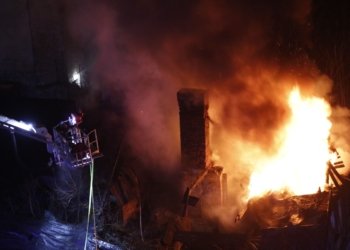

A Russian strike hit the building of the National Academy of Sciences of Ukraine in Kyiv on Monday. Emergency crews fought a fire and searched for people who may still be inside, with every emergency service responding, President Volodymyr Zelenskyy said.
Ukraine’s Foreign Ministry described a broader wave of Russian attacks on Kyiv and other regions. Four people suffered injuries in the capital.
Overnight into Monday, Russian drones damaged residential buildings and communications infrastructure in Kyiv. One air-raid alert on Sunday lasted more than nine hours.
At least two people died in the Kyiv region, including an Azerbaijani citizen.
Among those strikes one hit a nine-story residential building in Kharkiv, injuring at least 28 people, nine of them children.
Separate strikes also hit critical infrastructure in Vinnytsia, Dnipro, Khmelnytskyi and Zaporizhzhia regions, according to the ministry.
Ukraine needs stronger air defenses and sustained international pressure on Russia to stop the attacks and protect lives, the Ukraine ministry said.
According to Zelenskyy post on X, Russian forces struck a pharmaceutical company and gas stations in Kyiv and a business center in Dnipro. Elsewhere, he added, Russian forces struck civilian facilities, businesses and communications infrastructure. People died, he wrote, and he offered condolences to the families.
Neither Zelenskyy nor the ministry identified anyone who died or suffered injuries at the Academy building, and neither described how badly it was damaged.
After the Academy strike, the ministry urged UNESCO to strip Russia of its voice and voting rights within the organization. It described the Academy as one of Ukraine’s central research institutions, bringing together generations of researchers.
Every strike must receive a strong response and increased pressure on the aggressor, the ministry added.
Across the Academy’s institutes, scientific leaders report significant losses during the full-scale war. Attacks have destroyed scientific buildings, modern equipment, biological collections, archives and libraries, they wrote in a July open letter to the international scientific community.
That letter singled out the O.V. Palladin Institute of Biochemistry, which recently marked its 100th anniversary, for significant damage in an earlier large-scale strike.
Such losses are irreparable, the scientists wrote. The letter said the losses extend beyond Ukraine to the global scientific community.
The Organization also urged the international community to recognize attacks on civilian scientific institutions as war crimes. It called for public condemnation, documentation of the damage, support for rebuilding scientific infrastructure once the war has ended, and stronger protection for science in armed conflict.
“Science is the common heritage of humanity,” the letter says.
Rescuers were still searching the building on Monday as officials assessed the aftermath of the strike.