


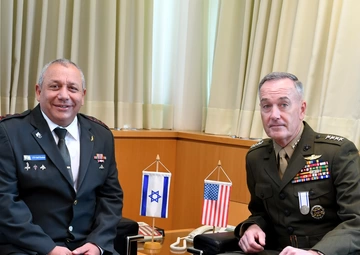
JERUSALEM, Nov. 7, Relish Wire — President Isaac Herzog has given Gadi Eisenkot the first chance to form Israel’s next government, passing over Prime Minister Benjamin Netanyahu even though Netanyahu’s Likud emerged as the largest single party from the Oct. 27 election.
With no bloc wining the needed 61 seats for a majority in the 120-member Knesset, Likud took 27 seats, according to the Central Elections Committee. Eisenkot’s Yashar took 21.
Herzog will formally confer the mandate on Eisenkot at the President’s Residence on Sunday, at 5 p.m. Eisenkot will then have 28 days, extendable by up to 14, to present a government that can win Knesset backing.
If he cannot, the process can move to another attempt or toward new elections.
In talks with all elected factions, groups with 67 seats backed Eisenkot meanwhile, Netanyahu was backed by groups with 46. A group with seven seats backed no one.
“The results of the consultations – seemingly clear, but the authority granted to me by law is to ascertain what the ability to form a government is – and this is not entirely clear in light of mutual disqualifications between the blocs and within the blocs themselves,” President Isaac Herzog said on Nov. 5 at the President’s Residence in Jerusalem.
Responding to the president’s announcement he framed the moment as a call for a national emergency government.
“This is the time to establish a national emergency government. I will do anything possible to prove us worthy,” Eisenkot wrote on X shortly after the president’s announcement.
Eisenkot, a former military chief who leads Yashar, has said he would not serve in a government led by Netanyahu, but in context, he previously served in Netanyahu’s government as a member of the emergency war cabinet before leaving with Benny Gant, an Israeli general and politician, in 2024.
The main anti-Netanyahu Jewish parties have about 48 seats. Arab parties have 19 seats. Netanyahu-aligned parties have about 53 seats. That is why Arab-led parties matter to Eisenkot: the Jewish opposition alone does not reach 61.
Eisenkot’s party, Yashar, has said any party or lawmaker joining an Eisenkot-led government must support its four missions, including recognizing Hamas as a terrorist organization and committing to dismantle its military and governing power.
Eisenkot has left open working with Arab-led parties if they accept those conditions, although he has previously said he did not believe they met them.
Meanwhile, Netanyahu on the other hand is pressing a different path, floating a national unity government as an alternative, while warning against a coalition that relies on Arab-led parties.
Yashar has urged Likud members to break with the parties it described as radical in Netanyahu’s religious-nationalist base.
A change of leadership could affect Israel’s approach to Iranas as well.
Although, Netanyahu has chosen a tougher approach, including pre-emptive military action and sustained pressure on Iran’s leadership.
Eisenkot on the other hand, is not softer on Iran’s nuclear ambitions, missile capabilities, or its regional proxy network, but has emphasized more limited military objectives: preventing Iran from advancing those capabilities, not making removal of its government a goal of war.
U.S. policy under President Donald Trump is a major factor. It would also shape any future decision on a major campaign against Iran.
The question now is whether Eisenkot can build a coalition that can win support in parliament. He must secure Arab-led backing on his terms, hold a divided opposition together, and answer Netanyahu’s unity offer with a coalition of his own.
