


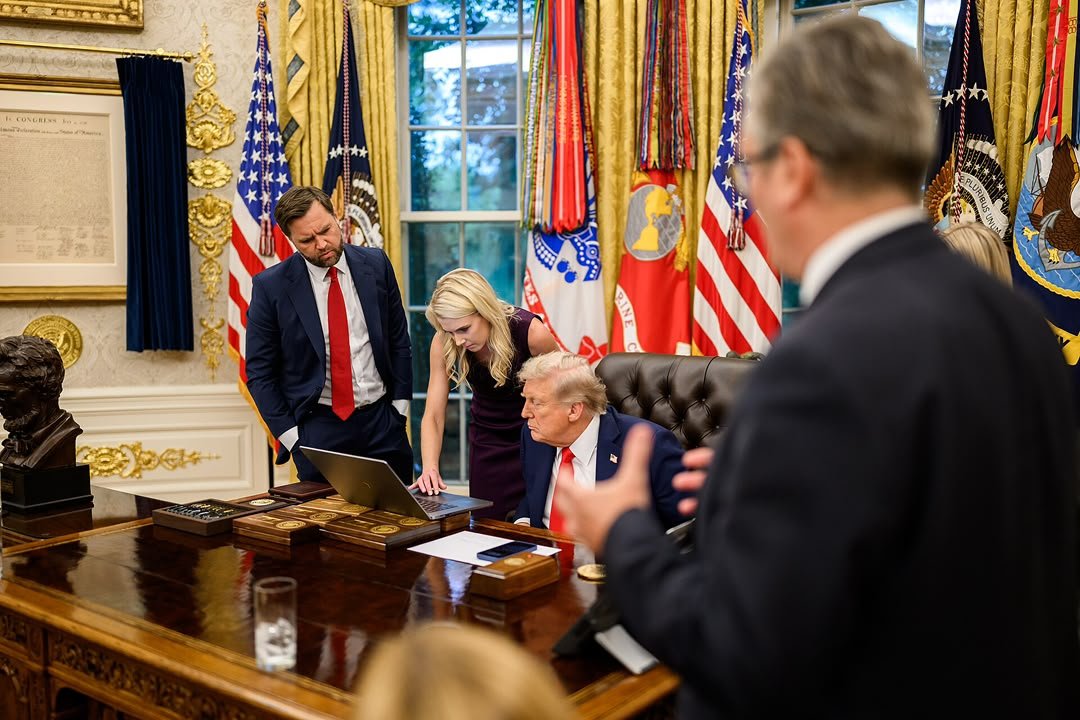
President Donald Trump gave Natalie Harp a $45,000 cash gift, while three other White House aides also received cash payments ranging from $20,000 to $45,000, according to newly released 2026 financial disclosures.
The four recipients were Harp, Margo Martin, Chamberlain Harris and Walter “Walt” Nauta.
Harp is a special assistant and executive assistant to the president. Martin and Harris — a White House communications adviser and the deputy director of Oval Office operations, respectively — each received $45,000. Nauta, director of Oval Office operations, received $20,000.
Each identified Trump as the source and described the payment as a holiday gift.
The payments have drawn scrutiny under 18 U.S.C. § 209, the federal statute barring outside supplementation of executive-branch employees’ salaries.
Richard Painter, a former White House ethics lawyer, says the gifts raise that concern directly.
“He’s clearly trying to make it easier for them financially to work in government service at the White House. You can’t do that. It’s not like tipping the doorman on Fifth Avenue.
If you want a job where you get tips, you shouldn’t be working for the U.S. government,” Painter added in an on-the-record interview with The Washington Post on Sept. 8.
The $45,000 is roughly one-third of their pay. For the three aides who received that amount, the figure sits against the $150,000 salaries they are said to receive in their White House positions.
According to The Washington Post on Sept. 8, White House spokesperson Davis Ingle disputed that. He said Trump has a longstanding practice of giving Christmas gifts to people in his orbit. That covers employees and aides in government, and from his time in the private sector.
“The gifts at issue here have nothing to do with any of these individuals’ official government duties, and therefore are entirely permissible under relevant legal and ethical standards,” Ingle said.
Under Section 209, an executive-branch officer or employee may not receive “any salary, or any contribution to or supplementation of salary” as compensation for government service from a source other than the U.S. government, or by anyone else on their behalf.
Specified exceptions include certain benefit plans maintained by former employers and qualifying relocation expenses.
At issue is whether the payments were sufficiently connected to their government service to fall within the prohibition.
Filings do not show Trump made the payments as an inducement for any of the aides to remain in government rather than leave for private-sector employment.
Three of the four — Harp, Martin and Harris — reported no other federal government position in the past 12 months. Nauta lists a prior role as executive assistant in the Office of the 45th President, a General Services Administration post connected to the presidential transition, running from August 2025 to January 2025 as listed on the form.
White House ethics officials certified the four reports as compliant with applicable laws and regulations. No authority has ruled on whether it violated the law.
Those revelations landed in an already combustible campaign climate. Weeks prior, on August 16 at an Atlanta rally, Sen. Jon Ossoff assailed the president’s inner circle in wider terms, declaring he
“doesn’t want to do the job.” He further charged that the ballroom project and travel with Harp had eclipsed governing, invoking “their apparently defenseless flying palace gifted by the Emir of Qatar.” The cash gifts themselves went unmentioned; those particulars had not yet come to light when he spoke.