
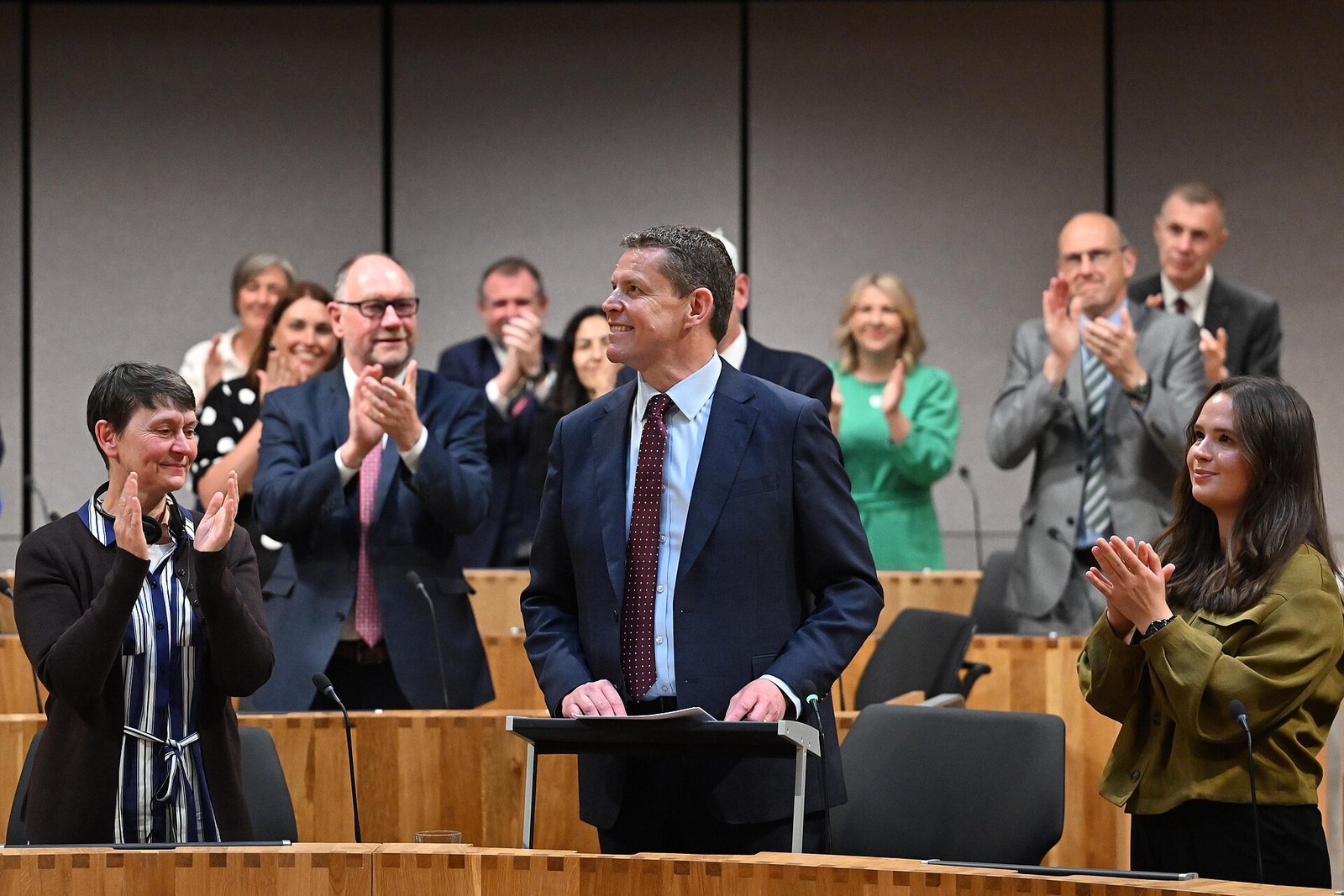
The leaders of the Scottish National Party, Plaid Cymru and Sinn Féin, who also serve as first ministers of Scotland, Wales and Northern Ireland, have declared that Westminster’s time is coming to an end and called on the UK government to prepare for constitutional change, as the three parties signed a joint memorandum in Cardiff.
The agreement brings the three parties together around a shared constitutional position. But the positions are not identical.
Michelle O’Neill pressed for a referendum on Northern Ireland’s future at the accompanying press conference, while Swinney’s referendum demand was set out in his 10 September letter to the prime minister.
Rhun ap Iorwerth has said there is no fixed timetable for Welsh independence or a referendum.
Four figures put their names to the memorandum. Swinney did so as SNP leader, while Ap Iorwerth represented Plaid Cymru. O’Neill signed as Sinn Féin vice president.
Mary Lou McDonald, the party’s president and leader of the opposition in the Irish Dáil, was the fourth signatory.
The three first ministers attended the Cardiff meeting as party leaders rather than as officials representing their respective governments.
Sinn Féin’s objective — a united Ireland — differs from the independence campaigns pursued by the SNP and Plaid Cymru.
The memorandum sets out a basic claim:
“Each of our nations has the right to determine its own future, through democratic means and in accordance with the wishes of its people.”
The parties say that, for the first time, Scotland, Wales and the north of Ireland are simultaneously led by first ministers committed to independence from the United Kingdom.
They also commit to closer cooperation on the economy, energy and relations with the European Union.
One demand is directed squarely at Westminster: the British government should “prepare for, plan and facilitate constitutional change in each jurisdiction.”
Downing Street rejected that role. A spokesperson for Prime Minister Andy Burnham said he was committed to delivering change across all four nations of the United Kingdom and believes strongly in the union.
The UK was at its best when people came together around shared values and problem-solving, rather than division, the spokesperson said. For the government, the focus would be household costs and economic security “rather than engaging in constitutional debates or further referendums.”
Swinney’s Scottish referendum demand was already on his agenda before Cardiff. In a 10 September letter to Burnham, he cited the prime minister’s Commons remarks the previous day, when Burnham said an independence vote was a matter for “when public opinion has changed to the point where the call has to be considered.”
Burnham had used that threshold when discussing a referendum on Irish unification.
Swinney took those remarks as acceptance “that a referendum should take place” once the threshold was met.
His next step was to ask for a meeting with the prime minister, with the aim of turning what he called an agreed principle into “a legal mechanism.”
May’s Holyrood election also featured in his argument. The SNP won a fifth term. Swinney described the result as producing a record number of pro-independence MSPs.
On 9 September, Burnham had addressed the issue directly in the Commons. He reaffirmed his commitment to the Good Friday Agreement and said a Northern Ireland “border poll” would be for the Northern Ireland Secretary to consider when public opinion had shifted decisively.
For Scotland, Burnham applied the same test. He said he was not aware of majority public support for another independence referendum and that none would follow “until that changes.”
Northern Ireland has a statutory referendum mechanism under the Northern Ireland Act 1998. Scotland has no equivalent mechanism.
The memorandum states that each nation will determine its future “in its own way and in its own time.”
Swinney had made a similar argument in July, saying the three nations were, for the first time, led by leaders who rejected the constitutional status quo. Labour’s change of leadership, he said, had reopened the question of “where power lies” across the United Kingdom.
He intended to work with the new prime minister. But there would be “no ‘off limits’” when it came to Scottish democracy.