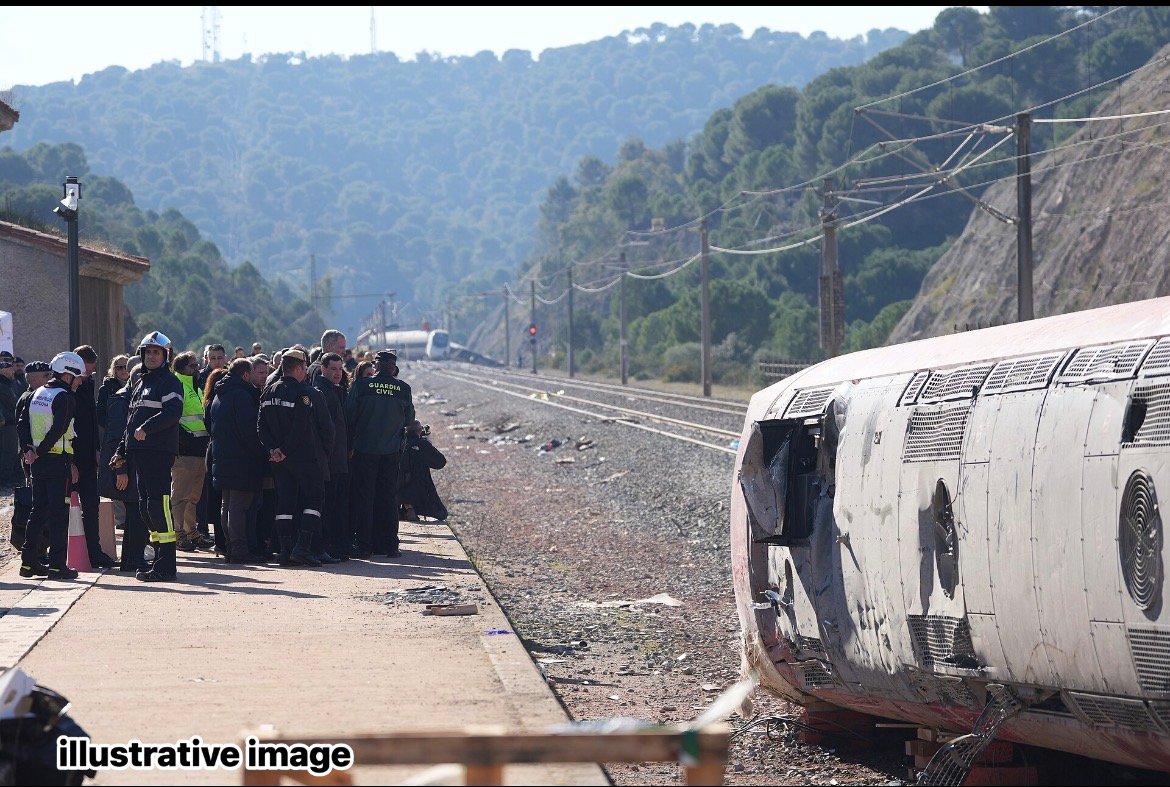
As rescue efforts continue and the death toll rises, at least 68 people have been confirmed dead when two high-speed trains collided in Toledo province on Wednesday, with officials warning the toll is provisional and likely to rise as rescue crews reach the most heavily damaged carriages.
At about 8:54 a.m. local time in Spain on Wednesday, October 28, the collision occurred, on the Madrid-Andalusia high-speed line near Urda, about 130 km south of Madrid.
#AccidenteFerroviario
— Guardia Civil (@guardiacivil) October 28, 2026
🚨 Imágenes de las labores de rescate de los efectivos del #GREIM y de #SeguridadCiudadana y de la evacuación de uno de los heridos por parte del #ServicioAéreo al Hospital 12 de Octubre.
🚔 Además de las unidades destacadas anteriormente, se han desplegado sobre el terreno cuatro #OMAC (Oficinas Móviles de Atención a la Ciudadanía), el #ServicioCinológico y el #ServicioDeMontaña
The Iryo service No. 6076 had left Madrid Puerta de Atocha around 7:54 a.m. bound for Seville, while Renfe’s AVE 2080 left the same station around 8 a.m. on the same route.
“Unfortunately, and that is the most important thing, the first data of the accident indicate that there are people dead and injured,” Renfe said in a statement on X*.
Authorities at the scene told CNN the Iryo train was stationary or moving slowly when it was struck from behind. Several carriages derailed, and at least two Iryo carriages went down an embankment.
Rail infrastructure manager Adif said it was a rear-end collision at kilometre point 118, between Mora and Orgaz and Urda, involving a Renfe service and an Iryo service on the Madrid-Seville route.
The Iryo 6076 train service had about 146 passengers and one baby, while the Renfe AVE 2080 train service had about 397 passengers, with both trains totaling 544 passengers.
Regional sources cited a breakdown of about 40 dead on the Iryo and 24 on the Renfe, as of this publication, with rescue efforts still at the scene.
A passenger identified only as Rey, who declined to give his surname, told CNN he was kept inside the train after the impact.
“There was terrible communication. No one could leave the trains for 10 minutes after the crash, we didn’t know what was happening.”
He said he injured his face and leg.
Adding, “I’m in pain, but there are people that need more help than I do.”
Relish Wire News could not confirm which train Rey was on.
Óscar Puente, Spain’s transport minister, said he had been at the ministry’s control centre since 9:40 a.m., gathering information about the crash.
His office in a statement noted he was leaving his agenda in Madrid and was travelling to Urda, the accident site to see the situation there.
No official cause has been announced. A formal investigation is underway, including by the Railway Accident Investigation Commission.
Reports of injuries have been totaled at about 100 or higher as rescue continues. Officials from the scene said dozens were taken to hospitals in Toledo, Alcázar de San Juan, Ciudad Real, Albacete and Madrid.
Rescue operations are still underway hours after the crash. The regional PLATECAM emergency plan was activated and later raised to a higher level while the Guardia Civil, firefighters, medical teams and helicopters were deployed, and the Military Emergencies Unit was requested.
Temporary treatment areas were set up in Urda. Authorities said crews had not yet fully reached the interior of the most damaged carriages, which explains why the casualty count remains provisional.
The company said it had activated a crisis cabinet and its assistance plan for victims and families, with a hotline at 900 10 10 20. Iryo and the 112 emergency service also opened helplines.
Prime Minister Pedro Sánchez said on X he was in constant contact with Transport Minister Óscar Puente and García-Page.
“The emergency services are working on the ground to attend to the affected people and guarantee their safety, in coordination with all the administrations involved.”
Adif suspended high-speed traffic on the Madrid-Andalusia line. Renfe said services between Andalusia, Ciudad Real and Madrid were halted with no date for resumption. The line remained closed Wednesday afternoon while recovery and investigation work continued.
Wednesday’s crash near Urda in Toledo was Spain’s second fatal two-train high-speed collision this year, after January’s crash near Adamuz in Córdoba killed 46, Both were on the Madrid-Seville high-speed line, about 200km apart.
In January, a rear carriages of an Iryo train from Málaga to Madrid derailed onto the adjacent track and were hit by an oncoming Renfe train from Madrid to Huelva.
Near Urda, a Renfe AVE train struck the rear of an Iryo train that was stopped or moving slowly. Investigators have yet to determine the cause, and the shared corridor and operators do not establish a common cause.