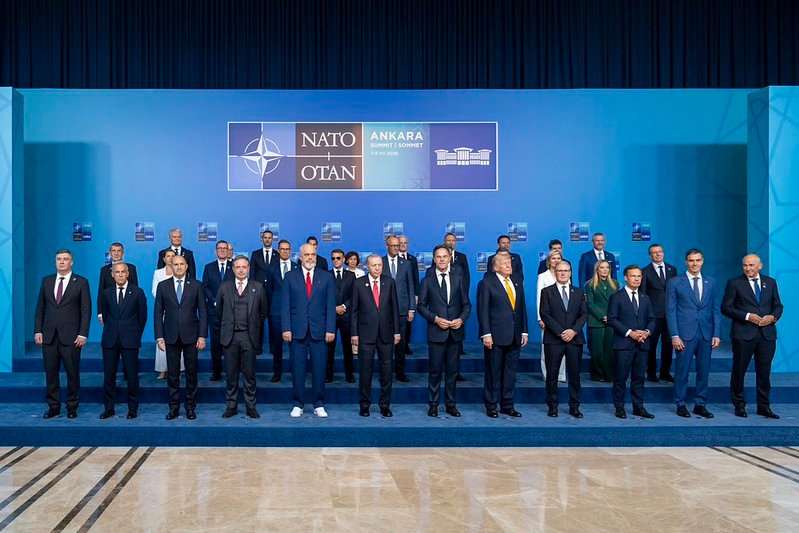
LONDON, July 6 — All 32 NATO members met the alliance’s decade-old defence spending target in 2025, but most fell short of a tougher goal set last year, leaving allies with little time to close the gap before the summit in Ankara.
Every member spent at least 2% of GDP on defence in 2025, the target set in 2014. Only a handful reached the tougher 3.5% core-defence goal agreed last year in The Hague.
European allies and Canada increased combined defence spending by 20% in real terms in 2025, to about $574 billion, according to NATO’s Secretary General’s Annual Report.
That is 2.33% of their combined GDP, still short of the 3.5% floor set for 2035.
NATO Secretary General Mark Rutte said allies should arrive in Ankara with ‘a clear and credible path’ toward the target.
Separate IMF fiscal reviews of Britain, France, Spain and Germany found defence spending is adding to pressure on public finances over the next decade.
Allies committed to the new goal at the Hague summit on June 25, 2025: 5% of GDP annually on defence and security-related spending by 2035, including at least 3.5% for core defence and up to 1.5% for broader items such as infrastructure and resilience.
They also agreed to submit annual plans showing “a credible, incremental path” to the target, with a review due in 2029.
France spent 2.05% of GDP on defence in 2025, Italy 2.01%, Spain 2.00%, Belgium 2.00%, the Netherlands 2.49% and the United Kingdom 2.40%.
Only Poland (4.48%), Lithuania (4.00%) and Latvia (3.73%) exceeded the new 3.5% core-defence threshold. Estonia (3.38%), Norway (3.35%) and Denmark (3.22%) moved closer to the target, while the United States spent 3.22% of GDP.
NATO Reports that the United States accounted for 52% of Allies’ combined GDP but 60% of total nominal defence expenditure.
Delivery remains the test
NATO’s Military Committee said on May 19 that rising defence budgets had yet to translate into military capability fast enough.
Its chair, Admiral Giuseppe Cavo Dragone, said the alliance was “on the right track” after The Hague, but “follow through and delivery is essential.” The pace of fielding capabilities “requires a dramatic increase and improvement,” he said, urging industry to accelerate production while Allies keep their commitments “with steadiness and consistency.”
Rutte repeated that message on June 10 at the Transatlantic Defense Industry Access Forum, saying Ankara ‘will not only be about cash, it has to be about combat-ready capabilities and significantly scaling up our defence industries.’”
Speaking in Berlin on July 1, Rutte said the summit would be ‘all about delivery’ — higher defence spending, more defence production and continued support for Ukraine.”
Fiscal pressures mount
Higher defence spending is colliding with fiscal pressures flagged in the IMF’s 2026 Article IV consultations.”
The IMF’s concluding statement on Britain warned that ‘rising pressures from ageing, defense, and the climate transition will require difficult choices to contain spending growth,’ and said the pressures could push public spending up by about six percentage points of GDP by 2050.”
The Fund’s statement on France also flagged defence, population ageing and green-transition investment as growing strains on public finances — with spending reaching 57.5% of GDP in 2025, the highest in the euro area.
Germany’s Article IV report said Executive Board directors backed medium-term fiscal adjustment to offset rising ageing and defence spending pressures, while welcoming reforms to Berlin’s constitutional debt brake that free up investment.
Spain’s report highlighted a different approach: after Madrid announced its national defence plan in April 2025, defence spending rose from 1.4% to 2.1% of GDP under NATO’s definition — with the IMF saying the increase was “partly accommodated through reallocation across spending items” rather than new fiscal outlays.
Uneven national progress
Trajectories remain uneven despite the wider momentum.
During a July 1 visit to Berlin with Chancellor Friedrich Merz and Defence Minister Boris Pistorius, Rutte said Germany ‘is on track to invest 3.5% of GDP in defence by 2029,’ calling it ‘an extraordinary achievement.’”
He also pointed to Germany’s permanent armoured brigade in Lithuania and a German-Netherlands corps command over NATO ground forces in Estonia and Latvia.
NATO’s Annual Report says alliance-wide spending on core defence requirements exceeded $1.4 trillion in 2025, while NATO Europe and Canada have more than doubled annual defence expenditure since 2014 — a 106% real-term increase.
Political pressure before Ankara
The NATO Parliamentary Assembly, meeting in Vilnius from May 30 to June 1, backed national efforts to reach the 5% target and called for allies to ‘accelerate delivery timelines well before 2035.’”
Lawmakers pledged that decisions taken in Ankara on capabilities, readiness, force generation, infrastructure, defence industry and resilience are “delivered quickly, at scale.”
In the foreword to his Annual Report, Rutte said Allies had made “huge leaps” in defence spending but must present “a clear and credible path towards the 5% objective” when they gather in Ankara.
the Alliance has comfortably cleared its long-standing 2% benchmark but remains about one percentage point of collective GDP below the new 3.5% core-defence floor, with wide disparities between members spending above 4% and others still around 2%.
“I expect the NATO Summit in Ankara this July to build on our achievements in 2025. There is no room for complacency and no time to waste, because the security of one billion people is at stake,” Mark Rutte said.