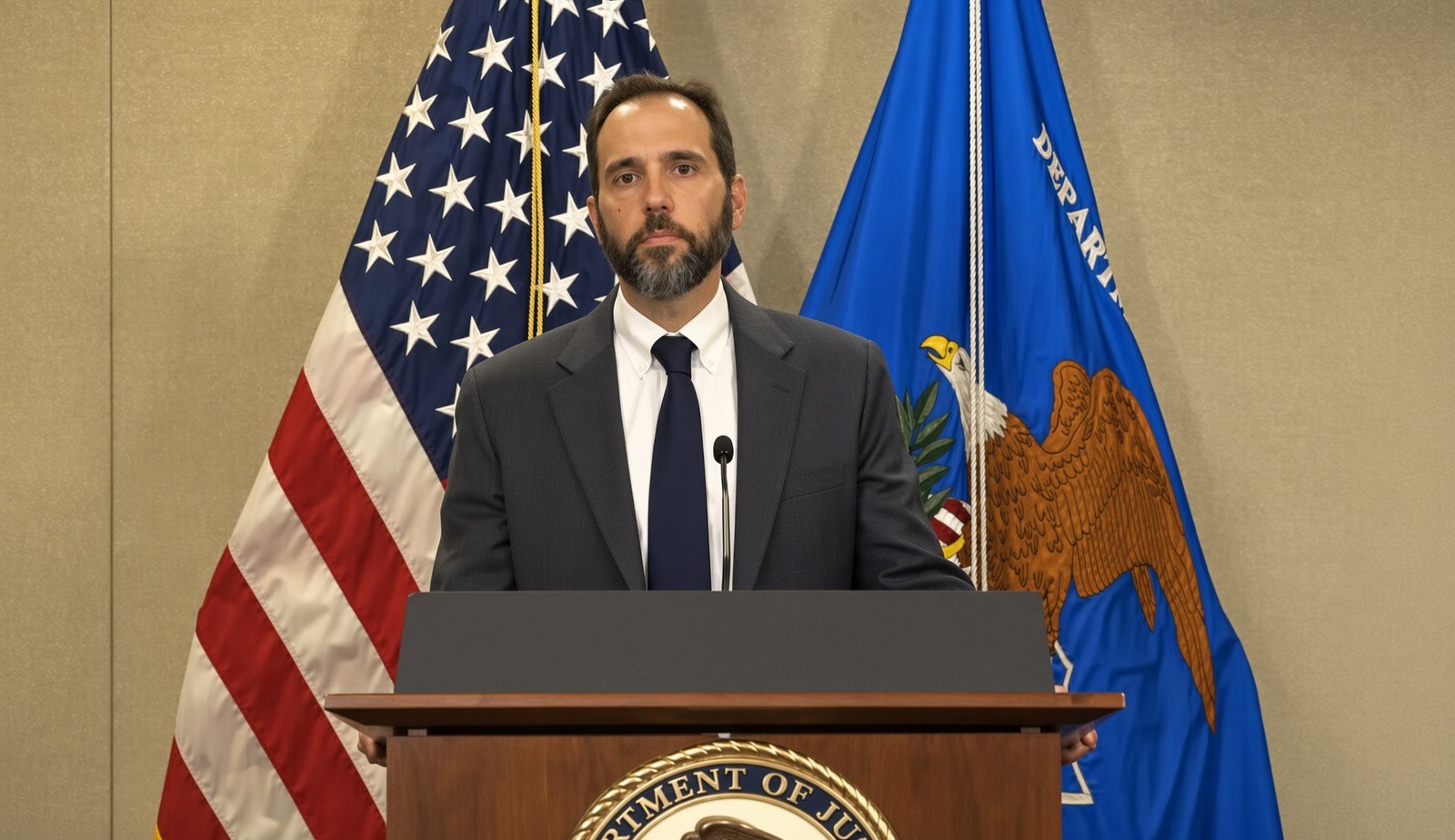
CAMBRIDGE, Mass. — Former special counsel Jack Smith, who led federal criminal investigations into President Donald Trump, used his first public interview since leaving office to accuse the Justice Department of targeting political opponents, protecting allies, and sidelining career prosecutors, telling a Harvard Law School audience, “What we are seeing today is not normal,” while urging young lawyers not to lose faith in public service.
Smith, speaking with Harvard Law professor and former special counsel colleague Alex Whiting at an event hosted by the school’s Center on the Legal Profession, said the Justice Department’s current leadership is abandoning long-standing traditions “because particular outcomes are wanted,” targeting individuals “because of their opposition to the president,” and declining to pursue investigations out of “fear of where an investigation would take them.”
Smith said he does not consider himself “a political person,” noted that he has held senior Justice Department roles under both Republican and Democratic administrations, including two positions during Trump’s first term—as acting U.S. attorney in Nashville and as a State Department appointee at an international war crimes tribunal.
Asked by Whiting how much of his concerns reflect the reality that “elections have consequences,” Smith agreed a new administration can shift policy—such as prioritizing immigration over environmental enforcement—but drew a sharp line between policy changes and what he called violations of the Justice Department’s unwritten core traditions.
He noted these norms are not formally codified, adding, “There’s not a thing in the Justice Department manual that says the president can’t tell you to prosecute his enemies. It doesn’t say that. Probably should say that now.”
Process Versus Outcomes
Smith framed his critique around two key measures of prosecutorial conduct: whether decisions are driven by “process versus outcomes,” and whether prosecutors follow the facts.
He warned that when a prosecutor is “so dead set on getting a certain outcome that they don’t care how they get there,” it should raise concern, likening it to “show trials” in Stalin’s Soviet Union, Nazi Germany, and the prosecution of Russian opposition figure Alexei Navalny—cases, he said,
“where the outcome is not in question, and the process is whatever process is necessary to get to the outcome you want.”
He pointed specifically to the prosecutions of New York Attorney General Letitia James and former FBI Director James Comey as examples.
According to Smith, an internal message to the attorney general—never intended to become public—instructed, “You have to go after these people.”
“Even though the career prosecutors said there was no case, that’s not process,” Smith said. “That is, ‘I want this particular outcome.’”
He added that in the James matter, “I’ve never heard of a case on those facts being brought” in thirty years of practice and said the department reportedly went “to multiple grand juries repeatedly to try to get an indictment.”
Smith also cited what he called “Signal gate,” referring to reports that officials discussed classified military plans over the Signal messaging app, and said the attorney general announced “there would be no investigation” the same day it became public.
“I can tell you with certainty that there is no administration, Republican or Democrat, since I’ve been a prosecutor, that would not open an investigation in that case,” he said.
He also drew a comparison to Minnesota, where he said victims of police shootings were being labeled “domestic terrorists… before a single fact is collected.”
The Public Integrity Section and a January 6 Adviser
Smith, who previously led the department’s Public Integrity Section—the unit responsible for prosecuting political corruption—said the office has effectively ceased to function.
“The public integrity section is in essence… technically there, but it’s in essence been disbanded, as I understand it,” he said, calling the loss “a jettisoning of expertise at the cost of the rule of law.”
He also singled out the treatment of career staff more broadly, saying he considers the “vilification of public servants” one of the more significant and underappreciated costs of the past year.
As an example, he told the audience that a current adviser to the attorney general was present at the U.S. Capitol on January 6, 2021, “telling fellow rioters to kill police officers,” adding, “It’s on video. That person is now advising our attorney general.”
Justice Department records show that on January 20, 2025, the department granted clemency — pardons and commutations — for “Certain Offenses Relating to the Events at or near the United States Capitol on January 6, 2021,” the first clemency action listed by the Office of the Pardon Attorney for the current administration.
A spokesperson for the Justice Department did not immediately respond to a request for comment.
Three Pillars: Competence, Integrity, Communication
Smith told the audience that a functioning Justice Department requires three things: competence, integrity paired with independence, and the ability to communicate with the public.
On competence, he compared the expertise of a career prosecutor to that of a heart surgeon, arguing that experience—hundreds of witness interviews and years of judgment calls—cannot be replaced by loyalty alone.
On integrity, he recalled that early in his career, pursuing or dropping a case based on a target’s politics “was just not on the table,” crediting his first supervisor with instilling that principle so deeply that even suggesting it, he said, “my boss would have literally thrown me out of [the] window.”
Communication, he said, is the area he has thought hardest about since leaving government, describing a “tension” between a prosecutor’s duty not to jeopardize a defendant’s right to a fair trial and the need to counter what he called well-funded, repetitive misinformation from represented parties.
“We need to find a way for prosecutors to communicate with people who don’t get to go to Harvard Law School,” he said.
A Message to Law Students and Career Attorneys
He was direct in urging students not to abandon plans for public service. Asked whether someone offered a Justice Department job today should take it, he said: “This one I can answer strongly and unequivocally… 100%, you should continue pursuing it.
The system is not going to work if good people are driven away from public service.”
He added, “We need people who will run towards the fire, not away from it,” and offered a broader maxim for public service: “If it’s not hard, it’s not service.”
He also referenced what he described as an attempted indictment “last week” targeting senators and members of Congress, saying it “was meant to inspire fear” and “make people self-censor,” but that the response instead was courage. “Fear is contagious, but so is courage,” he said.
On reform, He argued the country should move beyond simply restoring informal norms, pointing to the post-Watergate reforms—including the Inspector General Act and the creation of the Public Integrity Section—as proof that legislative fixes are possible.
He also warned that current safeguards leave a critical gap: “Imagine today that there is a criminal act committed by the president or one of his cabinet members.
How does that even get looked at?” he asked, arguing the government lacks “a mechanism… to combat corruption in the executive branch” if prosecutorial discretion is stripped away entirely.
Smith closed by defining the rule of law in simple terms — “treating people equally under the law” — and said that while he believes it is under threat, he remains convinced that shared values across the political spectrum, including a basic commitment to truthfulness, can still serve as common ground.
Asked who his personal hero was, Smith named his father, a factory worker who “never supervised a single person” but whose observations about the people who led him, he said, shaped how Smith has tried to lead prosecutorial offices throughout his career.
A Big Context
Smith led the Justice Department’s Special Counsel’s Office investigations into Trump’s handling of classified documents after leaving office and into efforts to overturn the 2020 election, cases that were the subject of oral argument before the U.S. Supreme Court in *Trump v. United States*, No. 23-939, argued April 25, 2024, on the scope of presidential immunity from criminal prosecution.
Smith departed the Special Counsel’s Office roughly a year before the Harvard appearance, according to his own account during the interview. He did not discuss the current status of those cases in detail, and this article does not characterize any ongoing proceedings beyond what he said on stage.