
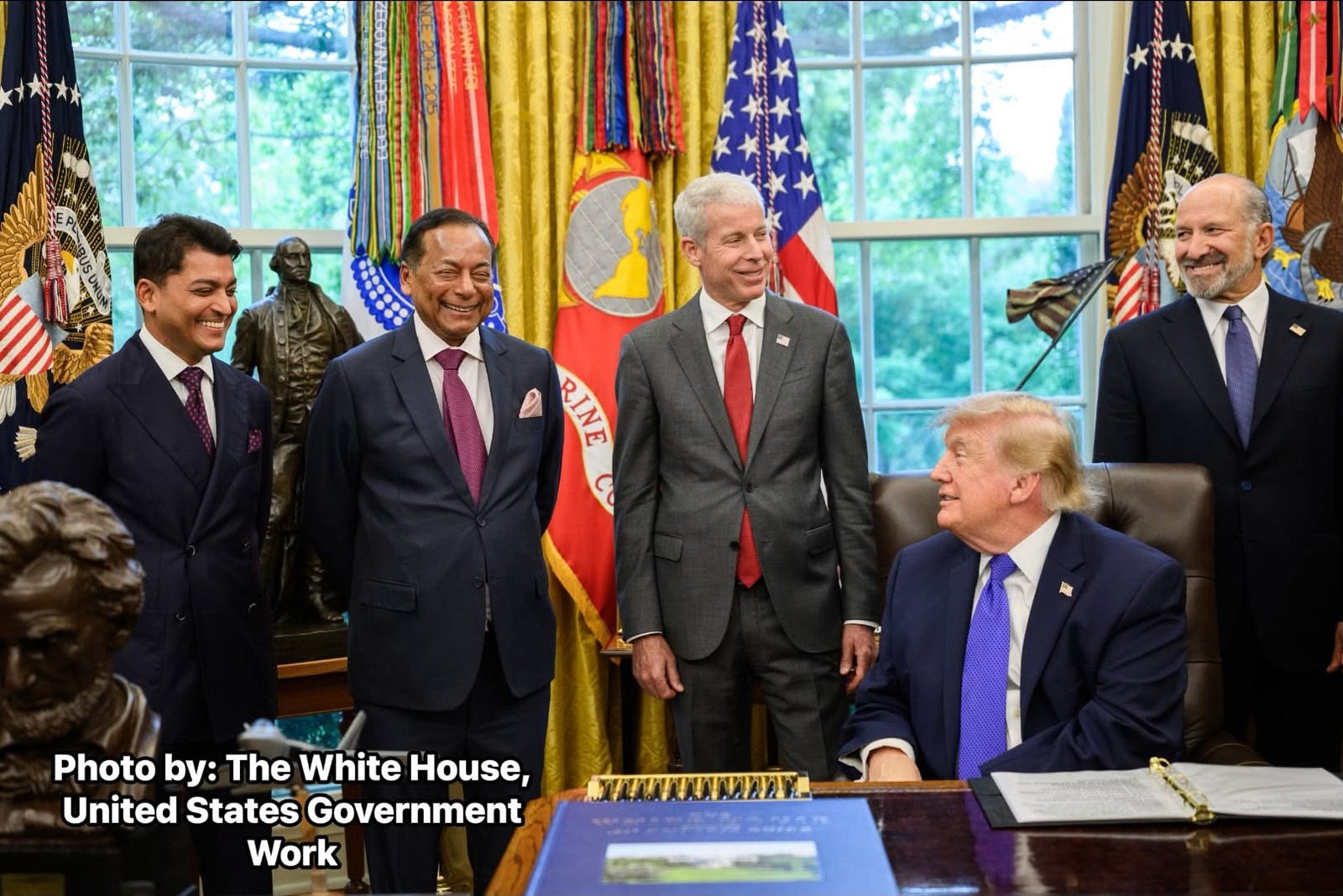
President Donald Trump and the heads of six of the country’s biggest artificial intelligence companies signed a voluntary safety accord at the White House on Tuesday. The agreement commits the firms to layered internal and outside checks on frontier models and to regular industry coordination on safety.
Trump called the pact “morally binding.”
The accord was signed by Trump, Sundar Pichai of Google, Dario Amodei of Anthropic, Mark Zuckerberg of Meta, Greg Brockman of OpenAI, Elon Musk of xAI and Jensen Huang of Nvidia. It applies to companies “training and deploying frontier models.”
What the agreement established is that “every company is responsible for developing its own technology safely and in a way that builds trust with customers and the public.” To carry that out, it establishes what it calls “four layers of controls and audits.”
Under the framework, each company will monitor its models’ capabilities and alignment during training and deployment, addressing areas like cybersecurity, biosecurity and chemical threats and seeking to ensure models do not “hack or access technical systems in unintended ways.”
An internal team must ensure those safeguards work and fix problems.
Each firm will also “partner with an independent external auditor or evaluator” to review the controls. An independent committee of each company’s board will supervise the process, “receive reports from the teams operating the controls and the internal and external auditors and evaluators,” and “ensure any issues identified are remediated.”
According to statements from the giant Al companies’ representatives, the layered system is meant to “give each company, its customers, and the public confidence that the technology is operating as intended.”
Separately, they have agreed that “the participating companies will meet regularly to establish standards and best practices to improve the safety of their systems.”
The commitment is voluntary rather than a government mandate. The agreement states the companies will implement the controls “regardless of whether this is required” and adds that “over time, it may make sense to codify these steps into laws or regulations.”
Pressed on whether the accord carries any force, Trump replied: “I think it’s morally binding.” He said, “It’s almost like a constitution, in a way.”
Speaker Mike Johnson called it a “joint commitment” and a “statement of principles” and said it would hold the companies to “robust internal controls” on a voluntary basis.
Trump noted the group also floated a 10-person panel to “watch over the enterprise.” An “AI czar” announcement is coming in three or four days, he said. He said he is seeing “tremendous self-policing” and argued companies will keep one another in check because “their companies are at stake.”
Reporters arguing that safety technology grows stronger as systems become more capable, Huang said “there’s no conflict between innovation, technology and safety.”
In a post on X, Pichai said the White House Accord and the Joint Commitment on Frontier Responsibilities provide “a solid basis for moving forward” with “real tangible steps to promote safe development.” He added that Google uses “testing, evaluations, red-teaming” and other safeguards, reviews models and products thoroughly before release, and will work with industry leaders to “establish norms and build public confidence.”
The signing follows reports from OpenAI and Anthropic of cases in which their models reached outside systems without permission or were misused. Some industry leaders, including executives at Anthropic and OpenAI, have called for slowing development, while Huang has argued some warnings are overblown.
On June 2, President Donald Trump signed an executive order directing agencies to design a voluntary framework under which AI developers could work with the government to decide whether their models meet the definition of covered frontier models. Under hat program, the government could receive access to such models up to 30 days before they are shared with other trusted partners, with safeguards for confidentiality, cybersecurity, insider risk and intellectual property.
The government said in Section 3 of that order that it does not authorize “mandatory governmental licensing, preclearance, or permitting” for new AI models.
Separately Tuesday, Trump ordered federal agencies, “to the maximum extent permitted by law,” to replace “Artificial Intelligence” and “AI” with “Super Intelligence” and “SI” across “official correspondence, public communications, websites, reports, policy documents, and other non-statutory” materials.
The order directs the Assistant to the President for Science and Technology to submit, within 60 days, “proposed legislative language to establish a Federal definition of” the new terms and to make “recommendations for any additional Presidential or executive action” related to the proposed definition.
The accord remains a voluntary commitment for now, while its signatories say the controls could eventually be incorporated into laws or regulations.