The Secret Service never established a joint communications room connecting federal, state, and local law enforcement before the Butler rally. As a result, the agency missed numerous warnings from local officers about a suspicious man observed with a rangefinder and long gun who later climbed onto the roof of the American Glass Research International complex.
The June 30, 2026 report identifies the communications failure as a central operational breakdown. Local officers’ warnings never reached the people who could have kept Trump off the stage. That finding sits inside a broader IG conclusion that the Secret Service “missed multiple opportunities to detect, prevent, and disrupt” the attempt.
Investigators concluded that the communication failure was part of a wider breakdown in protective operations.
A cascade of failures.
The findings said the Secret Service failed to detect the gunman’s drone because an inexperienced counter-drone operator was using malfunctioning equipment.
Intelligence on the long-distance threat was never shared with Pittsburgh Field Office leadership or the agents planning the event.
Despite receiving a Pennsylvania State Police plan showing those areas would remain unsecured, the agency did not secure the perimeter outside the official security zone and never used available resources to block sight lines from the American Glass Research complex to the stage.
The inspector General’s investigation were based on interviews with 92 witnesses, reviews of more than 70,000 documents, and a three-dimensional reconstruction of the Butler rally.
The office said the investigation uncovered information about the Secret Service’s planning and execution of the event that had not previously been reported.
Ten days to plan
The report reconstructs the events leading up to the attack, beginning on July 3, 2024, when Trump’s staff informed the Secret Service that he would hold a campaign rally in Butler ten days later.
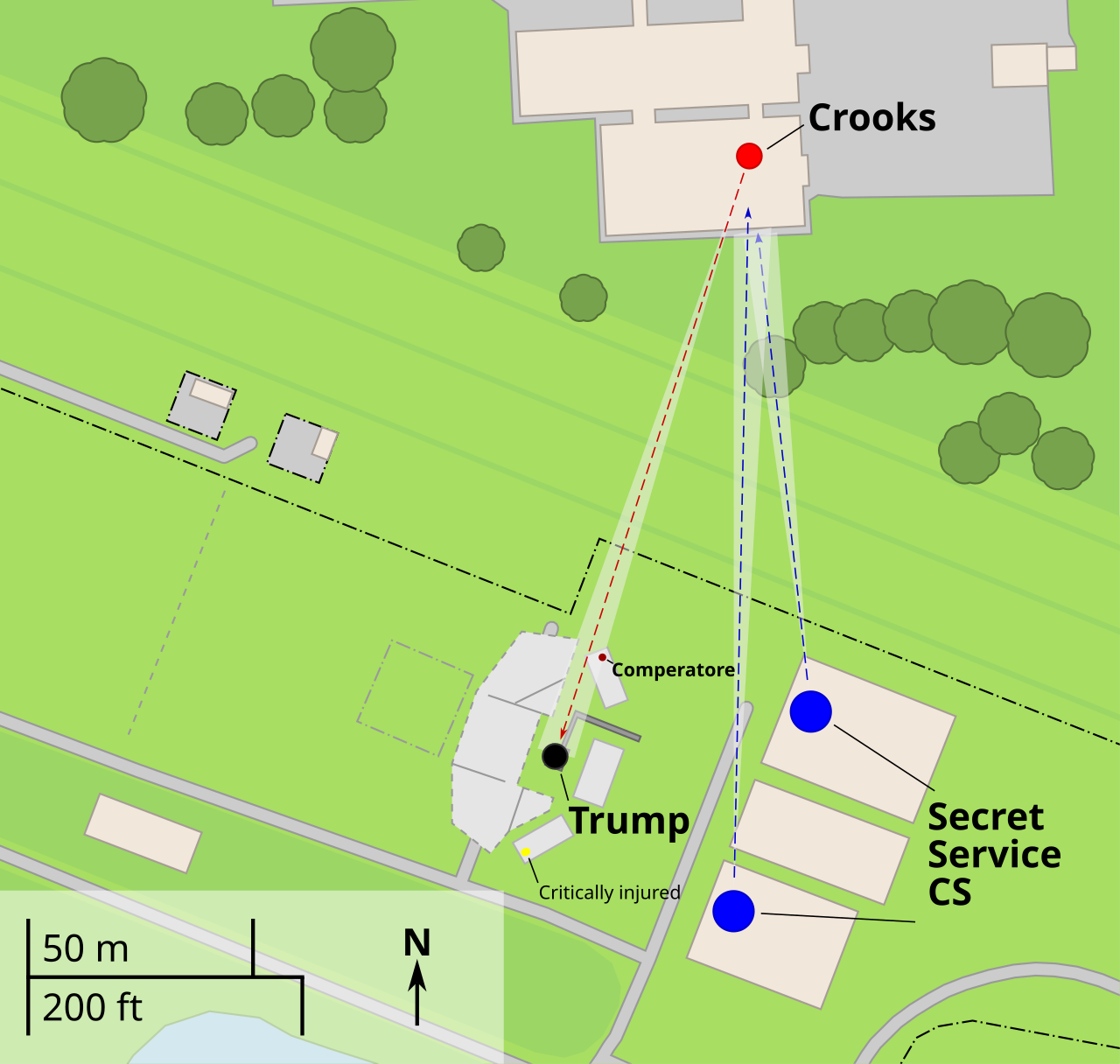
Secret Service planners established a security perimeter that included portions of the Butler Farm Show grounds but excluded the American Glass Research complex, where the gunman ultimately positioned himself.
The agency assigned personnel to specialized security roles, including counter-sniper teams, counter-drone operators, protective intelligence agents and communications personnel.
However, the Inspector General found that one request for a Technical Security Division counter-drone operator was denied while another request received no response, leaving the assigned operator without the additional support requested for the event.
On the afternoon of July 13, Thomas Crooks climbed onto the roof of the American Glass Research building and fired eight shots toward Trump, grazing the then-former president, killing attendee Corey Comperatore and wounding two other spectators.
He later concluded that these failures reflected broader weaknesses in Secret Service operations, citing inadequate policies, limited intelligence sharing and poor coordination with state and local law enforcement.
Investigators said those systemic shortcomings created the conditions that allowed multiple opportunities to detect and stop the attacker to be missed.
The Inspector General’s findings align with separate congressional investigations, but add new evidence about how broad the failures were.
A Senate report released by Homeland Security Committee Chairman Rand Paul in July 2025 found that Secret Service agents failed to communicate critical information about the suspicious individual to Trump’s shift detail—the very people who could have prevented him from taking the stage.
The committee also found that the agency denied multiple requests for additional personnel and security assets during the 2024 campaign, formally disciplined six employees but fired none, and that former Secret Service Director Kimberly Cheatle falsely testified to Congress that no security asset requests had been denied for the Butler rally.
Earlier, the House Task Force investigating the assassination attempt concluded that significant failures in planning, execution and leadership contributed to the security breakdown. After conducting 46 transcribed interviews, reviewing nearly 20,000 pages of records and holding public hearings, the bipartisan panel adopted a final report recommending 37 policy and structural reforms designed to strengthen Secret Service protective operations and prevent similar failures.
Seven fixes, four still open
The Department of Homeland Security Inspector General issued seven recommendations to improve the Secret Service’s protective planning and operational procedures. The agency agreed with all seven recommendations. According to the report, three recommendations have been implemented and closed, while four remain open pending additional corrective actions.
The Inspector General said its review of the July 13 attack is ongoing and that additional reports may be issued as investigators continue examining other aspects of the Secret Service’s protective operations surrounding the Butler rally.