
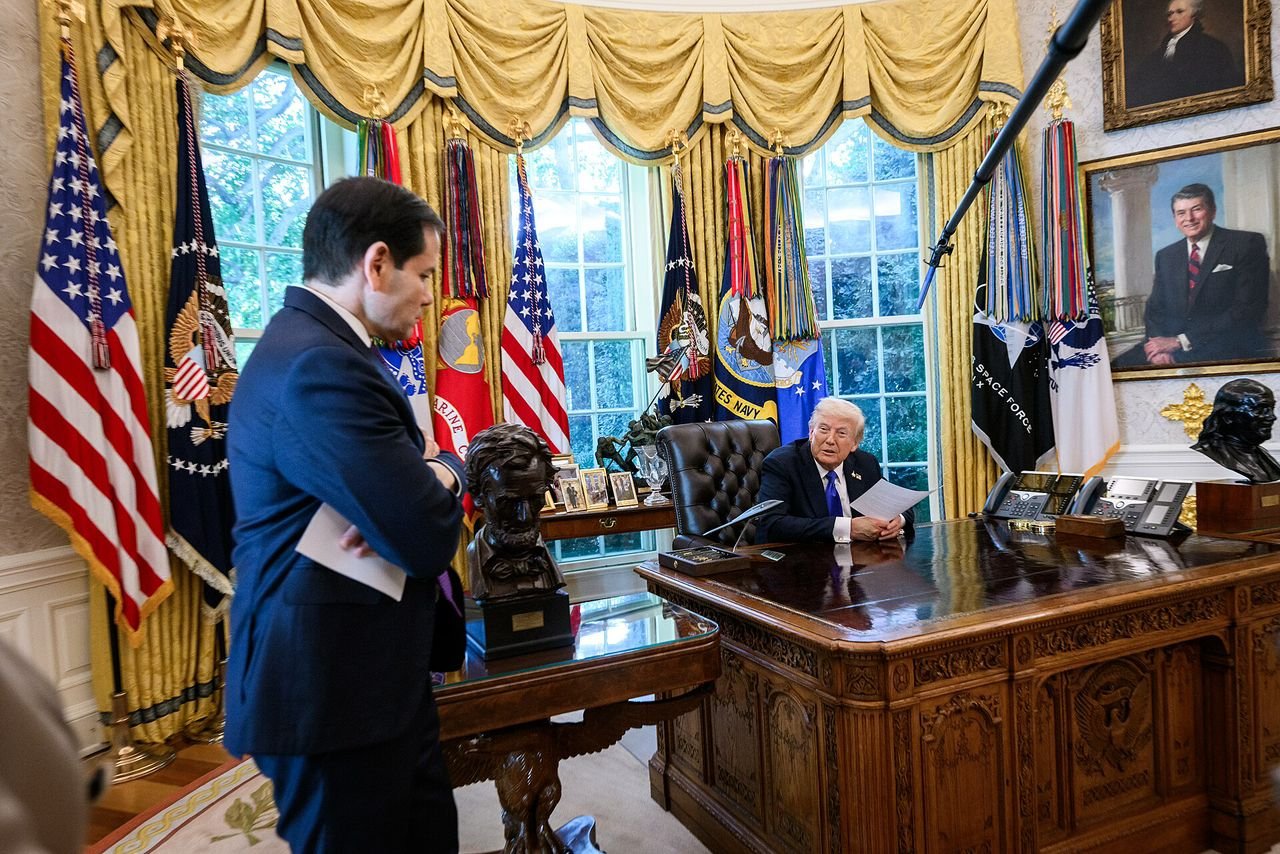
President Donald Trump confronted Defense Secretary Pete Hegseth at Camp David over the weekend. The Washington Post reported, citing two people familiar with the exchange, that Trump demanded to know why he had been misled about severe shortages of U.S. long-range precision missiles.
According to the outlet, Trump’s frustration over the Iran war hit a boiling point at Camp David, as munitions shortages now threaten to limit U.S. military options with Iran.
White House Press Secretary Karoline Leavitt denied the account in a statement posted on X.
“I was at Camp David with President Trump and Secretary Hegseth. This literally never happened, and we told the Washington Post that repeatedly,” she said.
“This B.S. story was shopped to many outlets by someone clearly out to disparage the Secretary, for whatever reason. Unfortunately for them, the President loves the Secretary and thinks he’s doing a tremendous job,” Leavitt added.
She called the story fake news.
Chief Pentagon spokesman Sean Parnell also dismissed the claims of depleted stocks and internal disagreement as made up in a statement to the Post.
He added that Hegseth never misled anyone about the military’s weapons supply posture and never pointed blame at Deputy Secretary Feinberg.
The dispute centered on U.S. long-range precision missile inventories.
Reuters cited three people familiar with internal supply data on U.S. missile stockpiles. Two of them said the U.S. has burned through nearly its entire stockpile of Army Tactical Missile Systems, known as ATACMS, and their successor, the Precision Strike Missile.
The Trump administration saw this drawdown in its stockpile just over five months into the war with Iran.
One source told the outlet the U.S. has used a little less than half its global Tomahawk cruise missile supply. A fourth source put it plainly — Central Command has been refilling the gaps by shifting weapons already stationed elsewhere around the globe.
those supply figures have been circulating inside the federal government over the past week.
The discussions centered on one question — how long can the U.S. keep striking Iran without dragging inventories down to levels that would hurt its ability to respond to other crises around the world.
One source told Reuters the heavy reliance on precision weapons came down to a deliberate choice: avoid the bigger risk of sending piloted aircraft into the fight.
The White House further pushed back on those claims with a statement from President Trump.
“The U.S. has massive amounts of munitions, especially of certain types. Additionally, large amounts are being manufactured and shipped to the U.S. as needed. Defense companies are building the largest number of plants and factories in our country’s history,” Trump said.
He also said “leakers” of what he called treasonous statements were being hunted down and that “long-term jail sentences will be sought.”
Parnell, responding separately to Reuters, said the U.S. military “is the most powerful in the world and has everything it needs.”
A CSIS analysis published July 27 tracked the toll on U.S. Patriot interceptors.
Stocks stood at roughly 2,330 before the war began on February 27. By the April 8 ceasefire, that number had fell to about 1,030. And despite new deliveries, it stayed below 1,000 through late July.
THAAD interceptors followed the same pattern, around 450 before the war, down to about 232 by the ceasefire, then climbing back to roughly 250 by late July as deliveries finally exceeded use.
There are no good alternatives to Patriot and THAAD for ballistic missile defense,” CSIS analysts Mark F. Cancian and Chris H. Park wrote.
They further noted that Navy ships carrying comparable Standard Missiles are typically stationed too far away to fill the gap.
Their conclusion was that burning through those interceptors creates a near- to medium-term risk to U.S. preparedness for a potential conflict with China in the western Pacific.
On July 21, Hegseth and Joint Chiefs of Staff Chairman Gen. Dan Caine testified, before the Senate Appropriations Committee, in support of Trump’s June 24 supplemental funding request.
Hegseth laid out the numbers: $20 billion earmarked for military readiness.
Another $40 billion, he said, would go toward expanding production capacity and speeding up deliveries of high-demand weapons systems.
That list included solid rocket motors, Joint Direct Attack Munitions, hypersonic weapons and counter-drone systems.
Caine framed the request around timing, telling the committee he was seeking the money “while in the window of opportunity, while time is still on our side.”
He pointed to security challenges in Europe, the Middle East and the Pacific as the backdrop for that urgency.
Sen. Susan Collins pushed back and said ammunition shortfalls had been known to the committee for some time, and that there had been bipartisan support for fixing them before the war with Iran started.
The Pentagon’s FY2026 budget request came in at $384.3 billion, combined across procurement and research, development, test and evaluation accounts.
Separately, a CSIS analysis for the FY2027 cycle pegged the administration’s request at $95 billion for weapons — on top of $21 billion sought through the supplemental.
Together, the analysts said, those numbers point to how urgently the stockpiles need rebuilding.
The Post reported the Camp David confrontation. The White House and Pentagon deny it occurred.
Reuters, separately, reported on U.S. precision-weapon stockpiles and the administration’s efforts to rebuild them.
Congress is still weighing the administration’s supplemental funding request, as the war with Iran heads into its sixth month.