Seven days after its incorporation, Safe America Media LLC received $143 million in Department of Homeland Security advertising work awarded without full and open competition. More than a year later, congressional investigators are demanding how the firm secured the contract, what its ties are to figures around DHS leadership, and where the money went
Safe America Media incorporated Feb. 6, 2025. A Senate letter records that the firm signed the $143 million agreement seven days later, on Feb. 13.
DHS used urgency acquisition authority in place of full and open competition. The legal footing it named was 41 U.S.C. § 3304(a)(2) and Federal Acquisition Regulation 6.302-2, the “Unusual and Compelling Urgency” provisions.
The contract DHS put in place was a multiple-award indefinite-delivery, indefinite-quantity contract capped at $200 million. Media buying, production and advertising campaign development sat inside that scope.
Time formed the central part of DHS’s justification. the Department of Homeland Security bound that urgency to President Trump’s Jan. 20, 2025, declaration of a national emergency at the southern border.
An advertising campaign had to begin at once, the border-security agency said, to prompt people in the country illegally to leave and to deter further illegal immigration. To shrink the time needed to field the campaign, the agency argued competition had to be limited. Delay, the justification warned, would let misinformation travel, feed continued illegal crossings and deepen what the department called a humanitarian crisis.
Then came the vendor selection.
Safe America Media and People Who Think alone reached the final limited-competition list. February market research by the border-security agency had already flagged four firms that held relevant experience, media relationships and capacity.
DHS’s procurement justification leaves a significant gap, offering no explanation for the exclusion of two companies identified in its research or for the $143 million allocation to Safe America Media.
Unexplained gaps in the justification produced a wider congressional inquiry. In November 2025 Sen. Peter Welch asked the DHS inspector general to determine whether then-Secretary Kristi Noem personally reviewed or approved the awards and whether the department had properly used procedures that avoided full competition.
Contracts, subcontracting records, payment information and communications with DHS were what the letters demanded. By March 2026 Welch and Sen. Richard Blumenthal had widened that inquiry to Safe America Media, The Strategy Group Company and People Who Think.
One relationship drew particular attention.
On March 3, 2026, Noem told the Senate Judiciary Committee that The Strategy Group had managed her political advertising. Benjamin Yoho led the firm; his wife, Tricia McLaughlin, was then DHS assistant secretary for public affairs. The same company took an $8.5 million South Dakota contract during her governorship, and Lewandowski hired Yoho to promote her memoir — earlier ties the senators’ letter records..
At issue was more than personal connections. Sought next were the companies’ first communications with DHS, relationships among those involved, subcontractors and invoices, every person and firm paid under the work, and whether any DHS personnel received compensation.
The Strategy Group has acknowledged receiving a subcontract from Safe America Media.
March 6 correspondence fixed payments to the firm at $226,137.17.
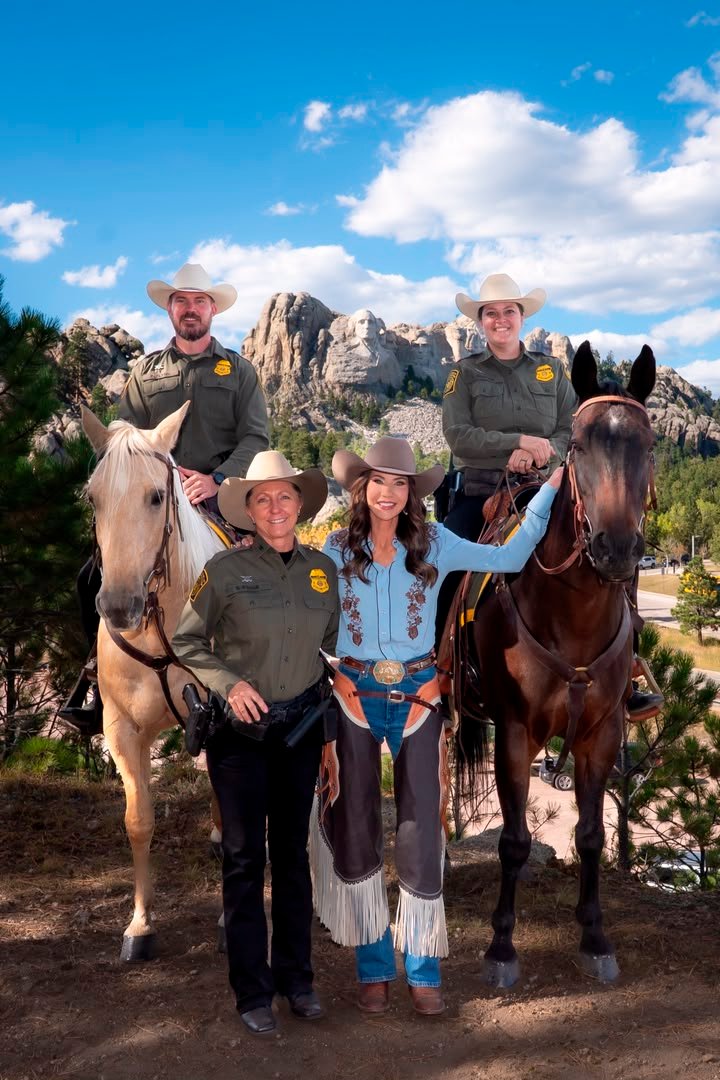
Writing DHS Secretary Markwayne Mullin on March 26, Welch and Blumenthal put the total at $286,137, a figure that included a $60,000 signing payment and $20,000 in horse-rental expenses.
Neither letter explains the discrepancy between the two figures. Federal spending records show three delivery orders under the Safe America Media award.
The first delivery order, issued Feb. 19, 2025, obligated $62 million. August brought two more: $15 million on the 15th through ICE for recruitment-campaign media placement, and $65 million on the 22nd for the subsequent phase.
Together, the three orders account for $142 million in recorded obligations.
What happened to the money after it reached the primary contractors is less clear. Those records — subcontract agreements, invoices, communications that could show how the funds were distributed — are what lawmakers say they still do not have.
Also under review is People Who Think. Managing partner Jay Connaughton had worked with Lewandowski on a Louisiana gubernatorial campaign and advised the Trump campaign.
Welch and Blumenthal’s March 26 letter to Mullin sought the DHS officials who approved exemptions from full competitive bidding on the Safe America Media and People Who Think contracts. The same letter sought a March 3 DHS memorandum on commissions and records of Lewandowski’s involvement, including whether he participated in or approved the awards.
The senators’ letter alleged that Lewandowski solicited payments from contractors or prospective contractors in connection with DHS business. Possible influence, direct or indirect kickbacks and personal benefit were named as matters requiring investigation.
For the companies, March 13, 2026 marked the deadline to respond; DHS had until April 9. Whether the requested information was ever produced is not clear from the record.